Research
We work with Hawaiʻi’s educators and communities to design and study technology for learning, caring for ʻāina, and keeping decisions about technology in community hands. Georgia Tech’s Ka Moamoa Lab is a research collaborator.
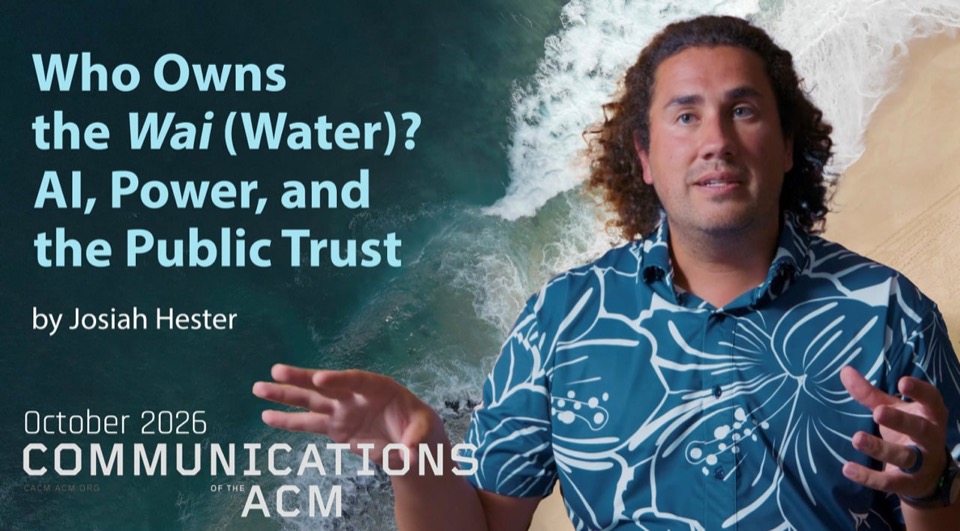
Who Owns the Wai (Water)? AI, Power, and the Public Trust
Josiah Hester · Communications of the ACM
Who gets to decide how AI uses land, water, energy, and labor? Drawing on Hawaiʻi’s kānāwai water law, Josiah Hester makes the case for treating AI infrastructure as a public trust. That question of community authority guides research at Ulu Lāhui Foundation and Ka Moamoa Lab.
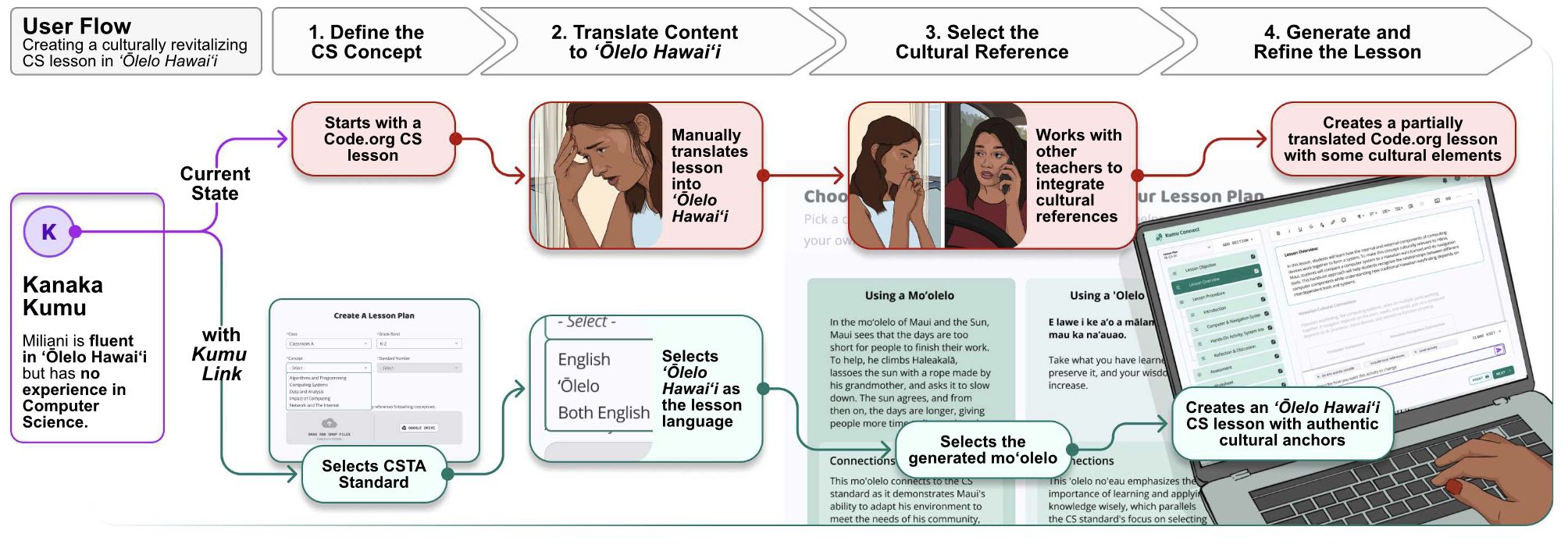
Kumu Connect
Kumu choose the language and cultural references for a computer science lesson. In the study, 36 educators across three Hawaiʻi schools evaluated how the tool supported their work.
One educator valued a suggested story’s connection to their place. Another asked how a teacher unfamiliar with Hawaiʻi would know whether a reference fit the lesson.
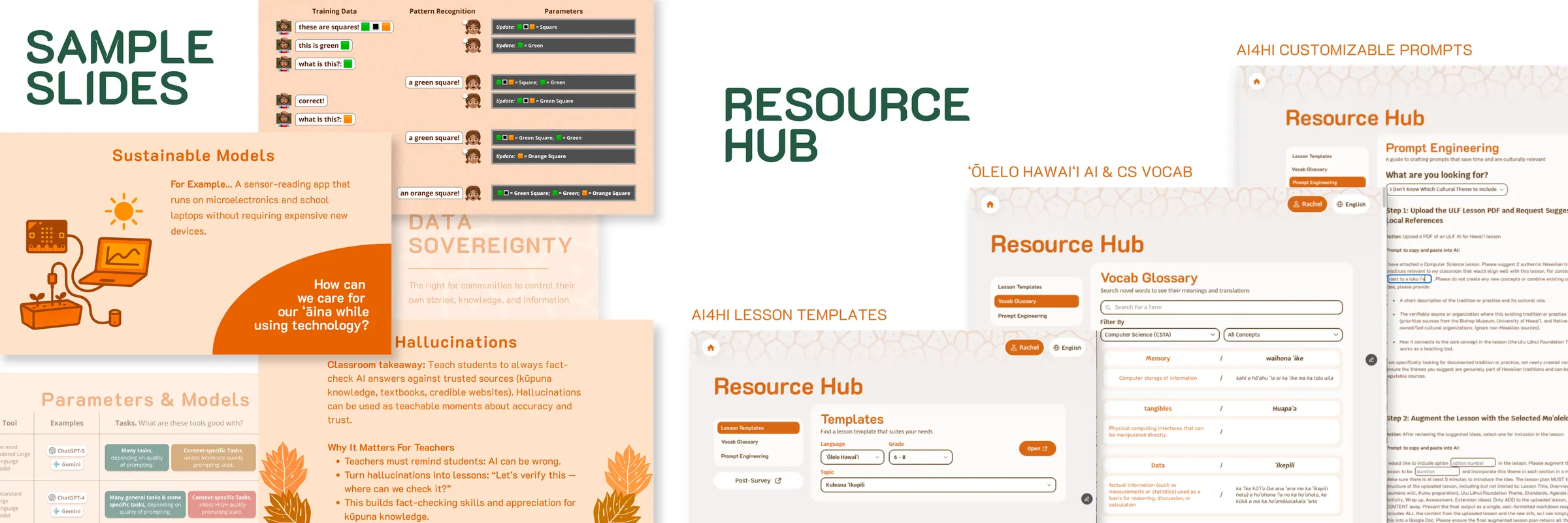
AI4Hawaiʻi
Kumu build AI lessons in ʻŌlelo Hawaiʻi and English. The workshop materials and resource hub give them a place to return for prompts, vocabulary, and lesson templates.
Publications
ULF-led
Work led by Ulu Lāhui Foundation.
-
AI4Hawaiʻi: Culturally-Grounded AI Literacy Training for K-12 Hawaiian Education Teachers
Rachel Baker-Ramos, Evyn-Bree Helekahi-Kaiwi, Alakaʻi Iaea-Russell, Chanelle Lokelani Chin Tolentino, Rebecca Diego, and Josiah Hester
SIGCSE TS 2027
Experience report on the design, delivery, and evaluation of the AI for Hawaiʻi workshops, offered in ʻŌlelo Hawaiʻi and English across six sessions, and their resource hub. Reports gains in AI literacy self-efficacy from 20 matched pre/post surveys and 84% lesson readiness.
Accepted; to appear February 2027. The publisher link goes live when the proceedings are published.
- Preprint (PDF) CC BY 4.0
- DOI 10.1145/3857222.3860234
ULF program evaluated
Studies of the programs and tools we build.
-
Kumu Connect: Culturally-Authentic AI Tools to Enable Educator Agency and Data Sovereignty for Hawaiian K-12 CS Education
Rachel Baker-Ramos, Manas Mhasakar, Viswak Raja, Evyn-Bree Helekahi-Kaiwi, William Gelder, Benjamin Carter, Rebecca Diego, Alex Cabral, and Josiah Hester
IDC 2026
The flagship technical paper: full system description and an evaluation with 36 educators across 3 schools, reporting a System Usability Scale score of 78 ("Good").
One educator valued a suggested story’s connection to their place. Another asked how a teacher unfamiliar with Hawaiʻi would know whether a reference fit the lesson.
- Publisher version
- Preprint (PDF) CC BY 4.0
- DOI 10.1145/3773077.3806104
-
Kumu Connect: Design Thinking for Place-Based Generative Educational Technology in Hawaiian Immersion Schools
Rachel Baker-Ramos, Will Gelder, Leah Cho, Jahnavi Kolakaluri, and Josiah Hester
RESPECT 2025
One-year co-design case study with 13 educators. Usability testing of an early design prototype produced a System Usability Scale score of 87 ("Excellent"); the later working system is evaluated in the IDC 2026 paper.
- Publisher version
- Preprint (PDF) CC BY 4.0
- DOI 10.1145/3704637.3734781
ULF collaborator
Research co-authored by members of our team.
-
Whose Knowledge Counts? Co-Designing Community-Centered AI Auditing Tools with Educators in Hawaiʻi
Dora Zhao, Hannah Cha, Michael J. Ryan, Angelina Wang, Rachel Baker-Ramos, Evyn-Bree Helekahi-Kaiwi, Rebecca Diego, Josiah Hester, and Diyi Yang
CHI 2026
Co-design workshops with 22 Oʻahu public school educators on community-centered AI auditing tools, in collaboration with Stanford University and Cornell University.
- Publisher version
- Preprint (PDF) CC BY 4.0
- DOI 10.1145/3772318.3790958
-
"I Would Never Trust Anything Western": Kumu (Educator) Perspectives on Use of LLMs for Culturally Revitalizing CS Education in Hawaiian Schools
Manas Mhasakar, Rachel Baker-Ramos, Benjamin Carter, Evyn-Bree Helekahi-Kaiwi, and Josiah Hester
CHI EA 2025
Survey of 15 educators, with interviews of 4 of them, on LLM use in Kaiapuni CS education; motivated Kumu Connect's cultural-alignment design.
- Publisher version
- Preprint (arXiv)
- DOI 10.1145/3706599.3720282
-
"Those don't work for us": An Assets-Based Approach to Incorporating Emerging Technologies in Viable Hawaiian Teacher Support Tools for Culturally Relevant CS Education
William Gelder, Rachel Baker-Ramos, Ayoung Cho, Jahnavi Kolakaluri, Judith Uchidiuno, and Josiah Hester
RESPECT 2024
Assets-based design research into a Hawaiian teacher-substitute support platform; identified the design requirements that became Kumu Connect.
- Publisher version
- Preprint (PDF) CC BY 4.0
- DOI 10.1145/3653666.3656066
Foundational research
Earlier research that informed our programs.
-
Enabling Restorative Hawaiian Futurism via a Tabletop Role-Playing Game and Digital Haʻi Moʻolelo
Rachel Baker-Ramos, Michael Parkin, Angelica Raza-Furtado, Alika Spahn Naihe, Jack Hobbs, Jeffrey Vierra, Aaron Ramirez, Chantel Rubin-Molina, Cheridean Kaaialii, Celeste Mason, Yaman Sangar, May Okihiro, and Josiah Hester
CHI PLAY Companion 2024
Kaona, a wellness-focused tabletop role-playing game for Native Hawaiian and Pacific Islander youth, developed with the Waiʻanae Coast Comprehensive Health Center. Foundational research from Ka Moamoa Lab, not a named ULF program.
- Publisher version
- Preprint (PDF) CC BY-NC-ND 4.0
- DOI 10.1145/3665463.3678822
-
Mālama ʻĀina through Micro:bits in Kāneʻohe: A Place-Based Approach to Teaching CS in a Kaiapuni (Hawaiian Immersion) Bilingual School Setting
Amanda Nelson, Amy Guo, Marcelo Worsley, Derek Esibill, and Josiah Hester
RESPECT 2023
Origin project: two years of micro:bit work at Waikalua Loko Iʻa fishpond, with solar-powered water-quality sensing, developed with Puʻōhala School and the Pacific American Foundation.
- Publisher version
- Accepted manuscript (NSF Public Access)
- DOI 10.1109/RESPECT60069.2023.00031
Commentary and media
Articles and media by members of our team.
-
Who Owns the Wai (Water)? AI, Power, and the Public Trust
Josiah Hester
Communications of the ACM, 2026
Opinion article in Communications of the ACM, volume 69, issue 10.
- Read the article
- Watch the featured video
- DOI 10.1145/3785371
-
What is Kumu Connect?
Kumu Connect team
Video, 2025
A two-and-a-half-minute introduction to Kumu Connect.