Where we work

Selected program locations. The Molokaʻi marker represents work on the island. Coastlines from the Hawaiʻi Statewide GIS Program and USGS.

Impact by Program

PLACES Education

At Waikalua Loko Iʻa in Kāneʻohe, students from Puʻōhala School programmed micro:bits and compared water readings with what they observed at the pond. Ulu Lāhui began putting its mission into practice there, delivering micro:bit and MakeCode lessons with the Pacific American Foundation through the original NSF Broadening Participation in Computing project. The program develops lessons and projects in ʻŌlelo Hawaiʻi and English with kumu and community partners.
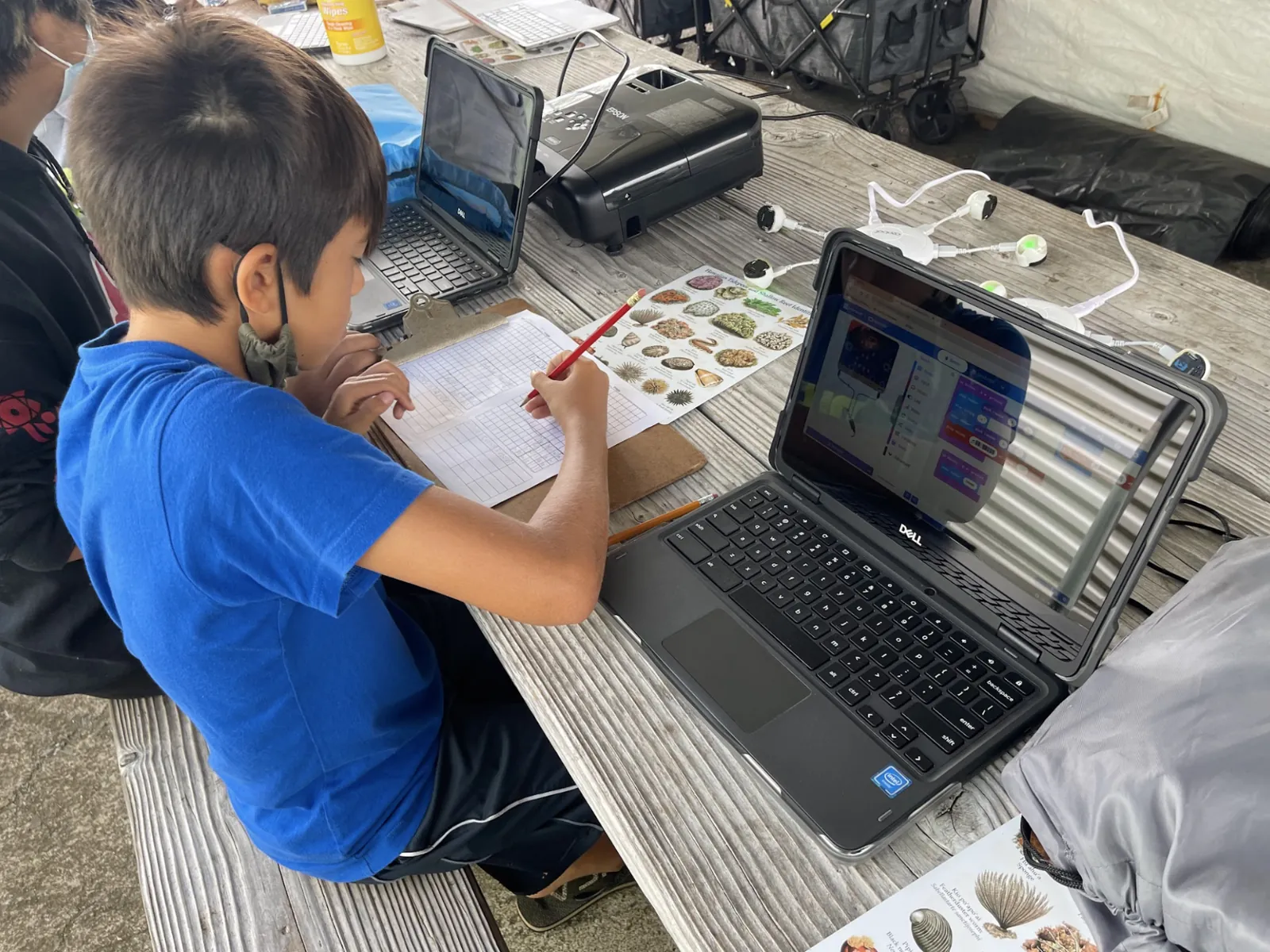
A student writes on a clipboard at a picnic table, next to a laptop showing block-based code and a chart of reef species.
Field notes beside block-based code and a reef species chart.

Kumu Connect

A kumu can choose a computing concept, set the language of instruction, and decide which cultural references belong in their lesson. They can bring their own moʻolelo and revise the draft before sharing it with students. In our evaluation, educators rated the generated lessons and suggested cultural references separately.

36 educators across 3 Hawaiʻi schools evaluated Kumu Connect.

4.20/5
educators’ average rating of the quality of suggested cultural references
4.45/5
educators’ average usefulness rating for the generated lesson
78/100
system usability score, rated Good

AI for Hawaiʻi

Kumu build a lesson for their own classroom while practicing how to spot errors in AI output, ask what data trained a model, and decide what information to share. They leave with a lesson draft and a resource hub with ʻŌlelo Hawaiʻi terminology, prompting templates, and examples they can adapt.

84%
of responding teachers said they could teach their lesson as written or with minor changes
4.7/5
resource hub usefulness rating
6
workshops delivered

Across 20 matched pre- and post-workshop surveys, teachers’ self-rated confidence rose by 1.20 to 1.65 points on a five-point scale across four AI literacy skills.

At a glance

70+
educators
33+
schools
6
complex areas

Source: AI for Hawaiʻi: Impact Report, 2026 (2025–2026).

Supporters

This work would not be possible without the support of aiEDU, the Hawaiʻi Department of Education (HIDOE), Google Research, and the National Science Foundation.

Meet our hui →